
Executive Summary
Organizations adopting artificial intelligence often focus first on identifying opportunities and use cases. Once selected, one of the earliest and most important strategic decisions is how these AI use cases should be developed. Should organizations build capabilities internally, buy solutions from vendors, or partner with specialized providers?
This article introduces the Strategy of Things (SoT) AI Build–Buy–Partner Decision Framework, which helps executives evaluate these choices and apply them across the AI capability stack.
Key insights include:
- AI adoption is fundamentally a capability development decision, not just a technology choice.
- Most successful AI strategies involve a hybrid approach, combining internal development, external platforms, and strategic partnerships.
- Capabilities that create competitive differentiation are often candidates for internal development.
- Foundational AI platforms and tools are frequently acquired from vendors to accelerate time to value.
- Partnerships can help organizations access specialized expertise and reduce execution risk.
- Applying the framework across the SoT 9-Layer AI Operating Model allows organizations to evaluate where capabilities should be built, bought, or developed through partnerships.
By approaching AI adoption through a structured framework, organizations can make more informed decisions about capability development, investment priorities, and long-term strategy.
Introduction
Artificial intelligence is rapidly becoming a strategic capability for many organizations. Companies are exploring how AI can improve operations, enhance products and services, and create new sources of competitive advantage. However, adopting AI is not simply a technology decision. It is a capability development decision that affects how organizations build expertise, manage risk, and compete in the future.
One of the first strategic questions executives must answer is: “Should we build AI capabilities internally, buy solutions from vendors, or partner with specialized providers?“
While the question appears straightforward, the decision is quite complex. AI capabilities span multiple layers of technology, data, operations, and organizational change. Choosing the wrong approach can slow innovation, increase risk, and divert valuable resources.
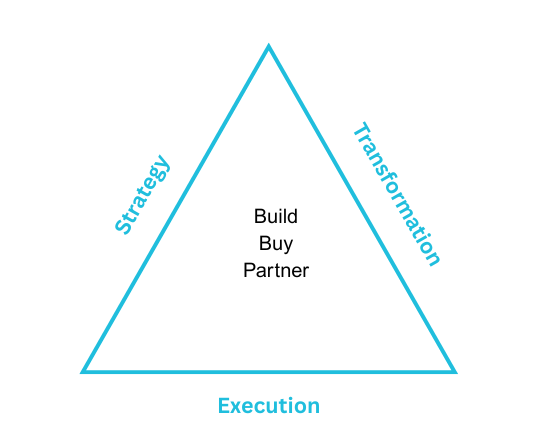
To help executives evaluate these choices, we use our SoT AI Build–Buy–Partner Decision Framework, which helps organizations determine where capabilities should be built internally, where they can be acquired from the market, and where partnerships can accelerate progress.
The SoT AI Build-Buy-Partner Decision Framework
Organizations adopting AI generally have three options for developing the capabilities they need.
- Build AI capabilities internally using in-house teams and infrastructure
- Buy platforms, tools, or solutions from third party commercial technology vendors
- Partner with specialized organizations that provide expertise, technology, or implementation capabilities
In practice, most successful AI strategies involve some combination of all three approaches. The challenge for executives is determining where each approach makes the most strategic and operational sense.
The SoT framework evaluates these build-buy-partner decisions across three key dimensions:
- Execution: Can the organization realistically build and operate the capability and should it?
- Strategy: Does the capability create meaningful competitive differentiation, operational impact or address critical priorities?
- Transformation: How well is the organization prepared to support the operational and organizational changes required?
Evaluating AI initiatives across these dimensions helps organizations determine where building internally is appropriate, where buying may accelerate progress, and where partnerships can reduce execution risk.
Option 1: Build AI Capabilities Internally
The “build” approach involves developing AI capabilities internally using the organization’s own talent, infrastructure, resources and intellectual property. Organizations may choose to build when AI capabilities represent strategic differentiation or involve proprietary knowledge and data assets.
Examples of such situations include:
- AI embedded within critical operations, proprietary products or services
- Models trained on unique operational or customer data
- Capabilities that directly influence competitive advantage
Building internally allows organizations to retain full control over intellectual property, development priorities, and long-term capability development. However, developing AI capabilities requires significant investment. Organizations must recruit or develop AI talent, establish data infrastructure, implement governance practices, and support ongoing operations. For companies early in their AI journey, attempting to build everything internally may slow progress and increase execution risk.
Companies consider this approach when:
- They have the requisite skill sets and resources to do it
- They can do it faster, cheaper and at lower risk
- This is a strategic competence they own or want to own
- There is strategic knowledge or critical intellectual property to protect
- They are fully committed throughout the company
Option 2: Buy AI Platforms or Solutions
The second option is to acquire AI capabilities by purchasing platforms, tools, or packaged solutions from technology vendors and suppliers. This approach allows organizations to leverage capabilities that already exist in the market rather than developing them internally.
Examples include:
- AI productivity and workflow tools
- AI analytics platforms
- Industry-specific AI solutions
- Cloud-based AI services and large language model platforms
Buying solutions can accelerate time to value and allow organizations to focus internal resources on higher-value initiatives. However, purchasing AI capabilities also introduces trade-offs. Organizations may have less control over customization, product roadmaps, and integration with internal systems. Vendor lock-in, cost management, and data governance must also be considered. Another factor is limited agility to respond in a timely manner to changing internal and customer needs. Buying typically makes the most sense for foundational capabilities that do not represent strategic differentiation for the organization.
Companies consider this approach when:
- This is not an area of core competence or an area the company wants to be core in
- They don’t have the skills or resources to build, maintain and support it
- There is some or all of a solution in the marketplace and no need to “reinvent the wheel”
- Someone can do it faster, better, cheaper and with less risk than they can
- They want to focus their limited resources in other areas that make more sense
- Time is critical and they want to get to market faster
- There is a solution in the market place that gives them mostly what you want
Option 3: Partner with AI Specialists
The third option is to partner with organizations that provide specialized expertise, technology, or implementation capabilities.
Partnerships may include:
- Advisory and strategy partners
- Technology implementation partners
- AI innovation partners
- Complementary industry solution providers
Partnering can accelerate AI adoption while reducing execution risk, particularly when internal capabilities are limited or when organizations need to move quickly. External partners can also bring experience from multiple AI initiatives, helping organizations avoid common pitfalls and accelerate early progress. However, partnerships require careful alignment of responsibilities, governance, and long-term strategy.
Companies consider this approach when:
- There is mutual benefit to partnering that goes beyond just monetary rewards (e.g. the parties co-develop intellectual property or expertise that used in other areas, market expansion, etc.)
- Each party brings unique specialized knowledge or capabilities, including technology, market access, and credibility
- The partners occupy complementary but different parts of the ecosystem (platform, applications, etc.)
- It lowers the cost, time and risk to pursue new opportunities
Evaluating the Decision: Three Critical Dimensions
While the build, buy, and partner options appear straightforward, determining the right path requires careful evaluation across three dimensions.
Dimension 1: Execution
The first dimension focuses on the organization’s ability to execute successfully. Executives should consider questions such as:
- Do we have the necessary skills to develop and operate AI systems?
- Do we have the data infrastructure required to support AI initiatives?
- Can we recruit and retain the talent needed to sustain AI development?
- Do we have governance, security, and operational processes in place?
- What am I willing to commit, sacrifice and re-prioritize to see this through?
- Am I willing to redeploy top management and company resources?
- How long am I willing to do this?
- How much budget and resources am I willing to commit?
- Is there anyone that can do it better than me? Does it make sense for me to do it? What am I willing to do and not do?
- What infrastructure (processes, policies, systems) do I have, or need to build, maintain, support and operate what I am building?
Execution capability often determines whether building internally is feasible.
Dimension 2: Strategy
The second dimension focuses on how AI capabilities align with the organization’s long-term strategy. Key questions include:
- Which AI capabilities create competitive advantage?
- Which capabilities represent foundational infrastructure?
- How important is speed to market?
- How much control over AI capabilities is strategically necessary?
- Do I have any critical proprietary technology, processes, and other intellectual property that I need to protect?
- What are the risks? How much risk are you willing to tolerate?
Capabilities that influence competitive differentiation may justify internal investment, while others may be better acquired externally.
Dimension 3: Transformation
The third dimension considers the organization’s ability to manage the broader transformation associated with AI adoption.
AI initiatives often require changes to:
- Workforce skills
- Operational workflows
- Governance and risk management
- Products and services
- Operations and technology Infrastructure
Considerations include:
- What is your corporate culture and how well does it support change?
- Do you have the right people to manage and sustain this change? Are you nimble and agile?
- What degree of disruption will there be to internal processes, channels, organization readiness, and business models? How agile are your current capabilities?
The ability to manage these changes may be as important as the technology decisions themselves.
A Simple 30 Second Test for Executives
Executives evaluating AI capabilities should begin with a simple rule of thumb.
Ask three questions:
- Does this capability create competitive differentiation? If yes, consider building it internally.
- Is this capability widely available in the market? If yes, consider buying it from vendors.
- Does this capability require expertise we do not currently have? If yes, consider partnering with specialists.
In practice, many AI initiatives involve a combination of all three approaches. The goal is not to choose a single path, but to determine where each approach makes the most sense across the organization’s AI capabilities based a review of the three dimensions (Execution, Strategy and Transformation).
Applying the Framework Across the AI Capability Stack
While the build–buy–partner decision is often discussed at a high level, AI capabilities span multiple layers of technology, data, and organizational capabilities.
At Strategy of Things, we often evaluate these decisions using our SoT 9-Layer AI Operating Model, which describes the major capability areas required to support AI adoption.
These layers include areas such as:
- Infrastructure and compute
- Data and knowledge assets
- Models and intelligence
- Development tools and evaluation
- Applications and automation
- Agents and user experience
- Governance and policy
- Adoption and enablement
- Strategy and leadership
Each layer represents a different set of capabilities that organizations must either develop internally, acquire from vendors, or access through partnerships.
Applying the SoT AI Build–Buy–Partner Decision Framework across these layers allows organizations to make more structured and practical decisions. For example, an organization may choose to:
- Buy foundational infrastructure and model platforms
- Partner with specialists to implement early AI initiatives
- Build internal capabilities in areas that create competitive differentiation
Rather than treating AI as a single technology decision, this approach allows organizations to develop a more coherent and scalable AI strategy. Each organization has unique needs, priorities and capabilities. As a result, the build-buy-partner combinations vary from organization to organization.
The build–buy–partner decision becomes more practical when evaluated across the AI capability stack. Figure 2 illustrates how organizations can apply the SoT AI Build–Buy–Partner Decision Framework across the AI capability layers required to support enterprise AI. The actual choices will vary depending on the company’s strategy, execution capabilities, and organization transformation readiness.
In practice, most organizations adopt a hybrid approach. For example, a company may:
- Partner with specialists to accelerate early projects
- Buy foundational AI infrastructure
- Build internal capabilities over time
The challenge for executives is determining where each approach is most appropriate across their AI initiatives. Applying a structured framework can help organizations avoid costly missteps and develop a more effective AI strategy.
| SoT AI Operating Model Layer | Build | Buy | Partner |
| Layer 9: Strategy and Leadership | AI strategy development | – | Advisory |
| Layer 8: Adoption and Enablement | Workforce training | Learning platforms | Change management |
| Layer 7: Governance and Policy | Governance frameworks | Compliance tools | Risk and legal specialists |
| Layer 6: Agents and Experience | Custom AI agents | Agent platforms | Implementation partners |
| Layer 5: Applications and Automation | Custom AI applications | AI-enabled software | Integration partners |
| Layer 4: Development and Evaluation | Internal development | AI development | Engineering partners |
| Layer 3: Models and Intelligence | Proprietary models | Foundation models | AI model specialists |
| Layer 2: Data and Knowledge | Data pipelines and governance | Data platforms | Data engineering partners |
| Layer 1: Infrastructure and Compute | – | Cloud AI infrastructure | Infrastructure providers |
Key Takeaways for Executives
Organizations adopting AI face an important strategic decision about how AI capabilities should be developed and acquired. The SoT AI Build–Buy–Partner Decision Framework provides a structured way to evaluate these choices.
Key insights for leadership teams include:
- Executives should treat AI adoption as a capability development decision, not simply a technology investment.
- Most successful AI strategies adopt a hybrid model, combining internal development, external platforms, and strategic partnerships.
- AI capabilities that create competitive differentiation are often candidates for internal development.
- Foundational AI platforms and tools are frequently acquired from vendors to accelerate time to value.
- Strategic partnerships can help organizations access specialized expertise and reduce execution risk during early adoption.
- Applying the framework across the AI capability stack, such as the SoT 9-Layer AI Operating Model, allows organizations to make more structured and scalable decisions.
Executives who approach AI adoption using a structured framework are better positioned to allocate resources effectively and avoid costly missteps.
Strategic Questions for AI Decision Makers
Once the strategic principles are understood, leadership teams must translate them into practical decisions about where to invest, where to leverage the market, and where to partner.
Some questions leadership teams should consider include:
- Which AI capabilities are central to our long-term competitive advantage?
Capabilities that differentiate the business may warrant internal investment. - Which capabilities are widely available as platforms or services?
Leveraging mature market solutions may accelerate time to value. - Where do we lack the expertise required to move quickly and effectively?
Partnerships may help organizations access specialized knowledge while reducing execution risk. - How should AI capabilities be developed across the broader AI capability stack?
Different layers, such as data, models, applications, and governance, may require different strategies. - Do we have the leadership and governance structures needed to guide AI initiatives across the organization?
AI adoption often spans multiple business units and requires coordinated decision-making.
Addressing these questions will help organizations move from experimentation to a more structured and scalable AI strategy.
Turning Strategy into Execution
Addressing these questions requires more than selecting technologies. It requires translating strategy into organizational action. For many mid-market organizations, the challenge is not recognizing the potential of AI. The challenge is navigating the complexity of the AI ecosystem and making the right strategic decisions early.
Our SoT AI Build–Buy–Partner Decision Framework helps organizations structure these decisions. However, applying the framework consistently across an organization requires evaluating multiple initiatives across the AI capability stack. Questions such as whether to build, buy, or partner are rarely addressed by considering purely technical answers. They require evaluating strategy, organizational readiness, risk tolerance, and long-term capability development.
The answers to these questions span multiple functions and departments. In many companies, answering these questions requires coordinated leadership across technology, operations, and business units. One best practice is to introduce dedicated central AI leadership roles that work across the organization to guide AI strategy and capability development.
For many organizations, this type of leadership is difficult to recruit. For others early in their AI journey, a full-time role may be difficult to justify. This is one reason many organizations are beginning to engage Fractional Chief AI Officers (CAIOs) to guide their AI initiatives.
A fractional CAIO can help organizations:
- Identify AI opportunities aligned with business strategy
- Evaluate build, buy, and partner options
- Design an AI operating model
- Guide early pilots and capability development
By bringing experienced AI leadership into the organization without requiring a full-time role, organizations can move forward with greater clarity and confidence.
Learn more about SoT’s Fractional Chief AI Officer services
If your organization is evaluating how to approach AI adoption, understanding the build–buy–partner decision is often one of the first strategic steps.
Strategy of Things works with mid-market organizations to design practical AI strategies and guide early implementations through our Fractional Chief AI Officer services.
This article is part of a continuing series aimed at providing senior leaders and managers with a practical working knowledge of artificial intelligence and how to manage it as a business capability. This article was originally published at Strategy of Things AI (SoT.ai) website.
Thanks for reading this post. If you found this post useful, please share it with your network. Please subscribe to our newsletter and be notified of new blog articles we will be posting. You can also follow us on Twitter (@strategythings), LinkedIn or Facebook.
Related posts:
Future-proofing Your AI Infrastructure
AI Is Everywhere. Enterprise Impact Isn’t. Here’s the Structure That Closes the Gap.