
The Pattern Most Mid-Market Leaders Are Living
You have pilots running. You have vendors engaged. You may have budget carved out of IT or operations, justified line by line to a CFO who wants returns before committing more.
Some of those pilots have shown real results. A workflow that runs faster. A decision that is better supported. A team reporting genuine productivity gains. You have seen what AI can do at the project level.
And yet, when you step back and look at the business as a whole, something is missing. Revenue has not moved. Margins look the same. The board is asking questions you cannot fully answer. The AI activity is real. The business impact is not.
The instinct is to look at the technology. A different model. A better vendor. A more sophisticated use case.
But in most organizations, the technology is not the problem. Something structural is missing. And for mid-market companies, that structural gap runs deeper than most people realize, because it is not just about having the right operating structure. It is about following the right playbook in the first place.
If you are responsible for AI in your organization and you do not carry the title of Chief AI Officer, or if you do but did not plan for it, you may be what practitioners are starting to call an accidental CAIO: someone who did not set out to lead AI strategy but has the accountability regardless. A VP of Technology. A COO with AI added to an already full plate. A senior operator handed a mandate and a modest budget.
The enterprise AI playbook was not built for you. Most mid-market companies are following it anyway. That is not a criticism. It is the most precise diagnosis available for why AI activity is not becoming AI impact.
The AI Divide Nobody Is Naming
There is a conversation happening about the gap between large enterprises and everyone else. Most of it focuses on the obvious: budget gaps, compute access, data science headcount.
Those differences are real. But they are not the deepest part of the problem.
The research tells a consistent story. McKinsey’s 2025 State of AI report found that only 39 percent of organizations report any measurable effect on business performance from AI. PwC’s 2026 Global CEO Survey found that 56 percent of chief executives saw neither higher revenues nor lower costs. Forrester estimates that over 60 percent of AI pilots fail to scale beyond controlled environments.
The structural problem is the same across organization sizes. Most companies are running AI as a collection of independent projects, each optimized for its own local outcome, none of them coordinated or connected to business strategy.
But here is where the divide becomes real.
A large enterprise can survive that mistake. They have the budget to fund retries. They have teams deep enough to absorb lessons and regroup. They can course-correct over multiple cycles and still find their way to impact.
You do not have that buffer.
You are not working with a dedicated AI budget line. You are carving investment out of existing IT allocations, operational funds, and whatever you can justify before the next budget review. You cannot fund a pilot purely to learn. You have no room for an initiative that stalls after six months of spend.
For mid-market companies, getting the AI strategy right is not a preference. It is a business necessity. And the right playbook looks fundamentally different from what enterprises follow.
Three Zones Where the Playbook Has to Be Different
To understand why mid-market AI requires a different playbook, it helps to think about AI not as a single technology but as a capability that spans three distinct zones. Each zone requires investment, decisions, and leadership. And in each zone, what the enterprise playbook prescribes is the wrong answer for a mid-market company.
The SoT AI Enterprise Reference Model maps all nine layers of an AI capability stack across these three zones. It was built to describe what a complete AI capability looks like at enterprise scale. Here we use it as a lens for understanding exactly where the playbook diverges.
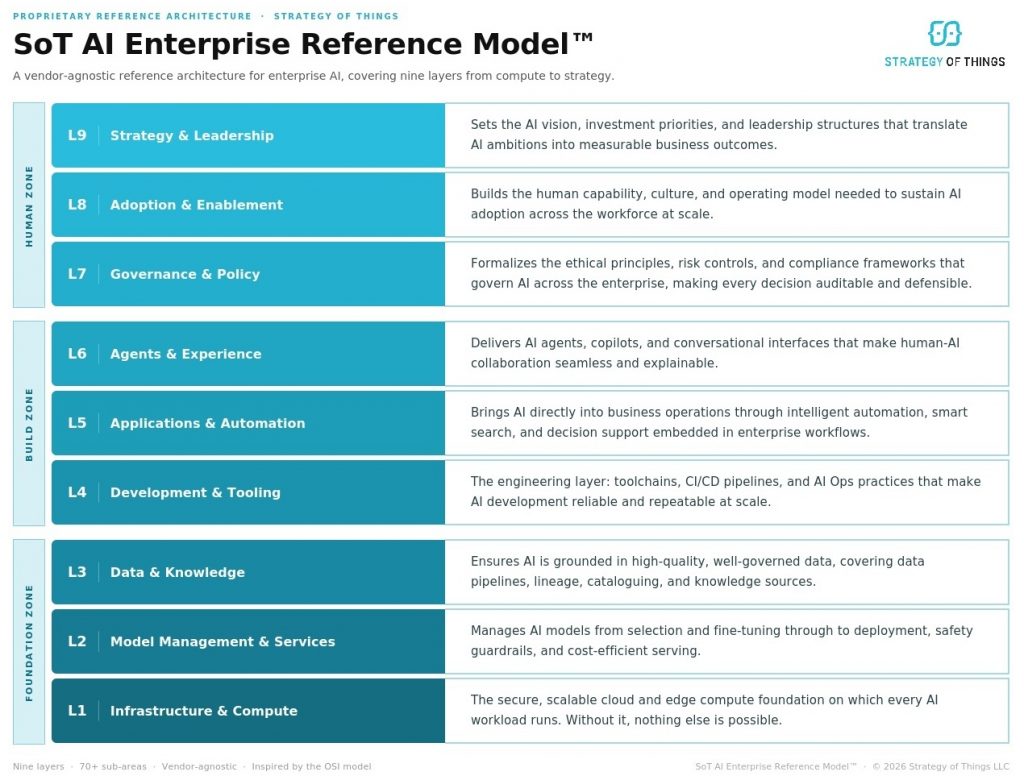
The table below shows how the enterprise playbook and the mid-market reality differ across each zone. Read it as a diagnostic: the more your current approach looks like the enterprise column, the more likely it is that your playbook is working against you.
| Zone | Enterprise Approach | Mid-Market Reality |
|---|---|---|
| Foundation (Layers 1-3) | Builds proprietary data platforms, fine-tunes its own AI models, and invests in dedicated compute infrastructure. This takes years and tens of millions of dollars to do well. Custom data pipelines, owned model training, and significant engineering headcount are assumed prerequisites before anything is deployed to the business. | Cannot and should not try to build what enterprise builds. The opportunity is to assemble rather than construct: leveraging cloud-native AI services, connecting existing business data to purpose-built tools, and making pragmatic decisions about what is good enough. The question is not what to build. It is what to connect and govern. |
| Build (Layers 4-6) | Invests heavily in custom AI toolchains, bespoke integrations, and internal development pipelines. The enterprise playbook treats this zone as a core internal capability to build and own over time. | Has a real advantage here that most people miss. The best mid-market AI strategies skip the custom build layer almost entirely and go straight to configuring and deploying pre-built AI applications and agents. Less engineering. Faster time to value. The trap is trying to build what should be bought, burning budget and time on custom work that a vendor has already solved. |
| Human (Layers 7-9) | Builds a formal AI leadership function: a Chief AI Officer, a governance committee, a portfolio management structure, and a dedicated change management program. This zone is staffed, budgeted, and treated as a permanent organizational function. | This is where mid-market companies can genuinely compete with enterprise. The right approach is not a scaled-down version of the enterprise model. It is a leaner, faster, more direct operating structure: clear strategic direction from leadership, lightweight governance that gets used, and adoption driven by proximity rather than bureaucracy. This zone does not require a large team. It requires the right thinking and the right accountability structure. |
Each of these zones is where the AI divide shows up most concretely. And each one requires a different set of decisions depending on your budget, your team, your data, and your business priorities. The cost of getting those decisions wrong shows up the same way in almost every mid-market organization.
A pilot shows genuine promise.
A pilot shows genuine promise. Results are real. Leadership wants to scale it. Then the questions start. Who owns the integration work? The IT team is already stretched. Where does the scaling budget come from? It was never in the plan. Who has the authority to take this from experiment to operation? Nobody has a clear answer.
The pilot stalls. Not because the AI failed. Because the foundation, build, and human decisions that scaling requires were never made.
This is not a technology problem. It is what happens when you run AI without a playbook designed for how your organization actually works.
The playbook you have been handed was not written for the accidental CAIO. It was built for a dedicated AI team, an enterprise budget, and an organizational structure that looks nothing like yours.
Where Mid-Market Has the Advantage
Before you conclude that the odds are stacked against you, consider what large enterprises are quietly envying.
- Speed. You can make a decision and move in weeks, not quarters. Enterprise AI initiatives travel through layers of stakeholder alignment, budget cycles, and organizational politics that slow everything down. You do not have that friction.
- Directness. You have a shorter distance between leadership and the people doing the work. AI adoption does not have to survive twelve layers of change management before it reaches the frontline.
- Focus. You are not coordinating thirty simultaneous AI initiatives across eight business units. You can identify the two or three highest-leverage opportunities across your three zones and go deep. That kind of focused approach, done well, generates more measurable impact than broad enterprise experimentation done poorly.
Mid-market companies that stop following the enterprise AI playbook and start building an approach designed for their own context do not just close the gap. In the areas that matter most to their business, they open one in their favor.
Where to Start
Understanding where you stand across all three zones is the right first step. Not at a general level, but specifically: your foundation, your build layer, and your human zone. Because where you are strong and where you have gaps shapes every strategic decision that follows.
We built a free 12-question “lite” AI maturity assessment for mid-market companies. One question for each layer of the AI stack. The assessment has been designed to be completed in about 10 minutes. You get a personalized maturity score and a set of targeted recommendations based on your specific situation, not a generic report written for a company ten times your size.
Everyone who completes the assessment receives the Mid-Market AI Strategy Handbook as a companion resource. It lays out what a different playbook looks like across all three zones, built specifically for mid-market organizations.
If you are responsible for AI in a mid-market organization and you are not getting the business impact you expected, the assessment is the right place to start.
This article is part of a continuing series aimed at providing senior leaders and managers with a practical working knowledge of artificial intelligence and how to manage it as a business capability.
Thanks for reading this post. If you found this post useful, please share it with your network. Please subscribe to our newsletter and be notified of new blog articles we will be posting. You can also follow us on Twitter (@strategythings), LinkedIn or Facebook.
Related posts:
The AI Build–Buy–Partner Decision: A Strategic Framework for Executives
AI Is Everywhere. Enterprise Impact Isn’t. Here’s the Structure That Closes the Gap.