


The gap: The missing structure for AI impact
 AI rarely fails because the technology doesn't work. It stalls because the structure needed to turn AI initiatives into enterprise impact is missing.
Running pilots is relatively easy. Scaling AI across a business is much harder. It requires integration into business processes and systems, alignment of budgets and infrastructure, workforce adoption, and ongoing operational oversight.
When multiple AI initiatives emerge across departments, the complexity increases quickly. Without a formal structure to coordinate them:
- Projects compete for limited budget and resources
- Teams duplicate tools, infrastructure and effort
- Ownership becomes fragmented across departments
- Decision authority and accountability become unclear
The result is familiar:
- AI pilots show promise but rarely scale
- AI investments fail to deliver measurable ROI
- Initiatives drift away from business priorities
- Enterprise risk exposure increases
AI activity increases. But enterprise impact remains limited.
The missing element is not technology. It is the executive structure required to manage AI as a coordinated enterprise capability.
How we turn AI into a business capability
Creating enterprise impact from AI requires more than launching projects. It requires an operating structure that allows leadership to coordinate strategy, investments, infrastructure, risk, and execution across the organization.
We call this structure the AI Operating Function.
Our Chief AI Officer solutions and services help establish this capability inside your company so AI initiatives can be directed, prioritized, governed, and scaled as a coordinated business portfolio.
The AI Operating Function acts as the leadership system that connects AI initiatives to business strategy, capital allocation, operational readiness, and measurable performance outcomes. We build this capability through four coordinated leadership areas that together manage how AI is directed, evaluated, governed, and scaled across the enterprise.
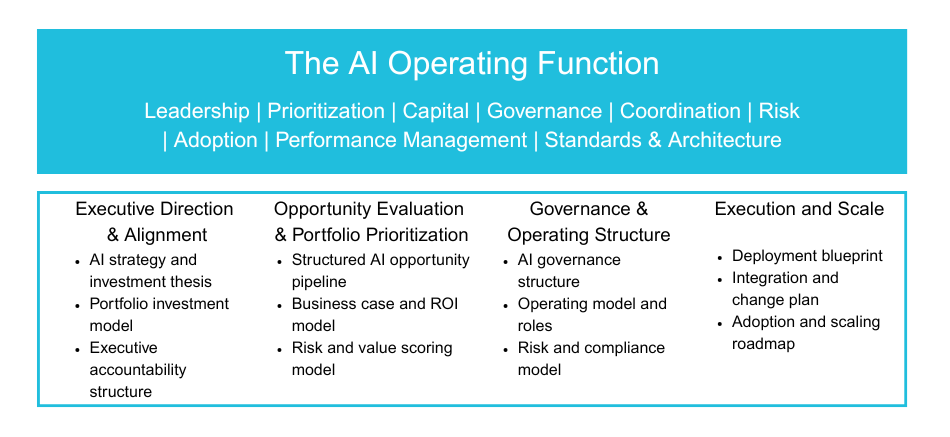
This operating function ensures AI is managed as a coordinated enterprise capability, not a collection of disconnected experiments.
This structure is grounded in our 9-layer SoT Enterprise AI Reference Model, which ensures AI decisions consider the full enterprise environment from infrastructure and data readiness to governance, adoption, and performance management.
Building Corporate AI Capability

Assisted Living (Healthcare)
SoT acts as fractional CAIO to build a sustainable, scalable AI capability, while also supporting the immediate execution of ongoing AI initiatives.
In addition to building the prioritized project portfolio, our work includes establishing AI leadership structure, governance model, and operating discipline needed to manage AI as a
Evaluating New AI Business Opportunities

Unmanned Aerial Vehicles
SoT designed and tested a proof-of-concept AI-enabled flight mission planning compliance platform and conducted a post-PoC business case analysis to determine the feasibility of developing an AI-enabled SaaS line of business.
This type of work helps organizations evaluate whether AI initiatives should scale into new products or business models.
Exploring the Next Generation of AI Capabilities

Digital Employees
Inside our internal innovation lab, SoT is designing and testing digital employees including a Chief of Staff, market researcher, strategic planner, and executive briefing writer.
These initiatives allow us to explore how AI agents and digital workers will reshape business operations and leadership decision-making. Insights from this work inform how we advise organizations on AI adoption and operational readiness.
Why us?
 AI is becoming strategically important for every business. But in the mid-market, every investment must produce measurable value.
Unlike large enterprises, most mid-market organizations cannot justify building a full executive AI leadership function early in their AI journey. Yet the need for coordination, governance, and strategic oversight still exists.
Without that leadership structure, AI initiatives often remain fragmented across departments producing activity, but not meaningful business impact.
This is why we provide Chief AI Officer solutions and services. We bring AI leadership, portfolio discipline, and governance structure designed for the unique needs of mid-market businesses.
We augment your leadership team, helping to prioritize AI investments based on business value and feasibility, aligning initiatives to measurable outcomes, coordinating infrastructure readiness, and establishing the oversight required to scale successful initiatives.
Our perspective comes from more than two decades of work building enterprise operating capabilities across environments influenced by organizations such as Gartner, Accenture, Deloitte, PwC, and Cisco, and applied across telecommunications, financial services, healthcare, industrial, and public sector environments.
Across multiple innovation cycles, from IoT and infrastructure modernization to emerging AI technologies, we observed a consistent pattern: technology expands faster than executive oversight.
In those environments, our work focused on helping leadership teams introduce the structure required to convert fragmented initiatives into sustainable operating capability.
AI is not a new structural problem. It is a new technology exposing an old one.
Our role is to help organizations build the leadership structure required to turn AI activity into measurable business capability.
Latest Insights

AI Is Everywhere. Mid-Market Impact Is Not. You May Be Following the Wrong Playbook.
Most mid-market companies are doing AI. Pilots are running, vendors are engaged, and budgets have been committed. But when you step back and look at the business as a whole, the impact is not there. The problem is not the technology. It is the playbook. This post explains why the enterprise AI playbook does not work at mid-market scale, what a different approach looks like across three critical zones, and where to start.

AI Project Prioritization: Building an AI Portfolio That Delivers
Building an AI portfolio that delivers enterprise impact requires a prioritization methodology that is significantly more rigorous than most organizations expect. This article explains what effective AI project prioritization actually requires, how to move from a ranked list to a deliberately constructed portfolio, and what separates organizations that treat prioritization as a discipline from those that treat it as a meeting.

Your AI Projects Are Competing Against Each Other. You Just Can’t See It.
AI is everywhere. Enterprise impact isn’t. The gap between the two is not a technology problem but a structural one. Most organizations manage AI as a collection of one-off projects, missing the synergies, wasting resources, and blocking their own highest-value initiatives. This post makes the case for AI project prioritization and portfolio thinking as the operating discipline that changes that.
Too much vendor hype and not enough clarity?

AI vendors promise transformational outcomes, but it can be difficult to determine what is real, what is feasible, and what actually matters for your business.
Let’s talk about how and where AI applies to your organization.
Too many AI ideas and not sure where to start?

Many organizations quickly accumulate multiple AI initiatives but lack a structured way to prioritize them based on business value, feasibility, and risk.
We can help evaluate and prioritize your AI portfolio.
Where do digital employees fit in my business?

AI agents and digital workers are beginning to reshape how work gets done. Understanding where they create value requires thoughtful design and operational planning.
We can help explore where they may make sense in your organization.
What could a fractional CAIO do for my business?

Many mid-market companies need AI leadership but are not ready to build a full executive AI function. A fractional CAIO provides the needed functions without the overhead.
Let's talk about what a fractional CAIO can do for your organization.