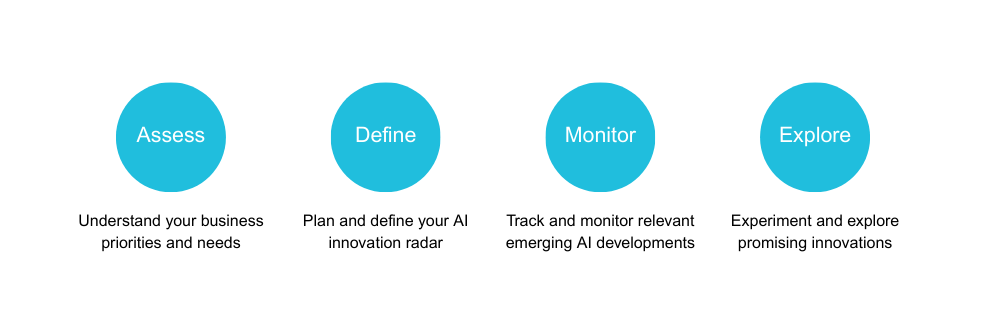
Where we help
 Artificial intelligence is evolving rapidly. New models, tools, frameworks, and capabilities appear almost weekly.
For many organizations, these developments are not just interesting. They are strategically important.
AI innovations can create new competitive advantages, reshape cost structures, automate previously manual work, and introduce entirely new business capabilities.
In highly competitive markets, staying aware of meaningful innovations can help organizations move faster than their competitors. In industries facing margin pressure, new technologies may provide opportunities to automate processes, improve productivity, or reduce costs. And in sectors vulnerable to disruptions, understanding emerging capabilities early can help organizations become more resilient and adaptable.
Leadership teams need to understand:
- Which AI innovations may eventually affect their industry
- Which technologies could reshape their operations
- Which developments could create competitive advantage
- When those technologies become mature enough to evaluate (When to consider)
The challenge is that AI innovation is happening across hundreds of companies, research labs, startups, and open-source communities around the world. Organizations face several challenges trying to keep up:
- Too many AI developments to monitor
- Limited internal capability to evaluate emerging technologies
- Difficulty separating meaningful innovation from hype
- Uncertainty about when technologies are mature enough to seriously consider and invest resources
Most organizations simply do not have the internal capability to continuously monitor, evaluate, and experiment with emerging AI innovations in a way that is tailored to their business.
This is where the SoT AI Innovation Lab helps.
AI Radar for your business
The SoT AI Innovation Lab acts as AI radar for your business.
AI technologies rarely move directly into enterprise deployment. Instead, they evolve through stages of maturity.
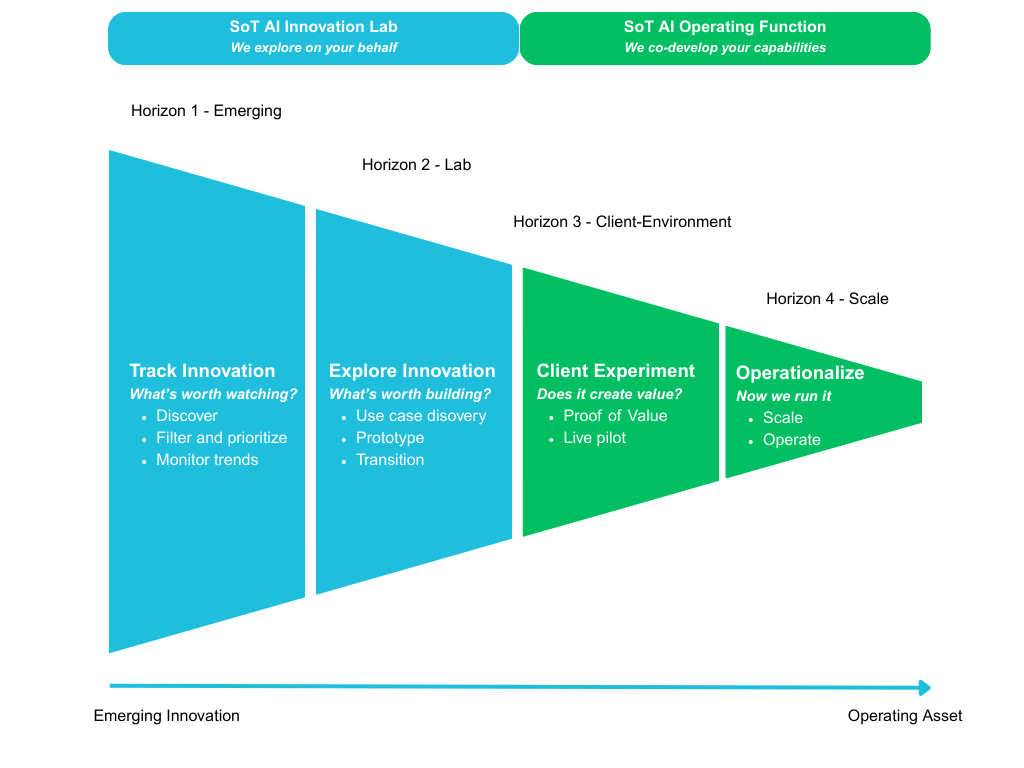
In the earliest stages, technologies are promising but unstable or incomplete. As they mature, they become suitable for experimentation and early prototyping. Eventually they reach a point where organizations can test them in their own environment through proofs of value and use case pilots.
We continuously monitor emerging technologies, identify those that may eventually affect your industry and operations, and experiment with promising developments long before they become enterprise technologies.
The SoT AI Innovation Lab operates primarily in the early stages of this lifecycle before technologies are ready for enterprise deployment.
This allows leadership teams to:
- Stay aware of meaningful AI developments
- Understand potential business implications early
- Experiment with promising technologies safely
- Prepare for adoption when the time is right
Instead of reacting to AI change after it happens, organizations can see what is coming and prepare accordingly.
SoT AI Innovation Lab
The SoT AI Innovation Lab helps organizations make sense of the rapidly evolving AI landscape through a disciplined process.
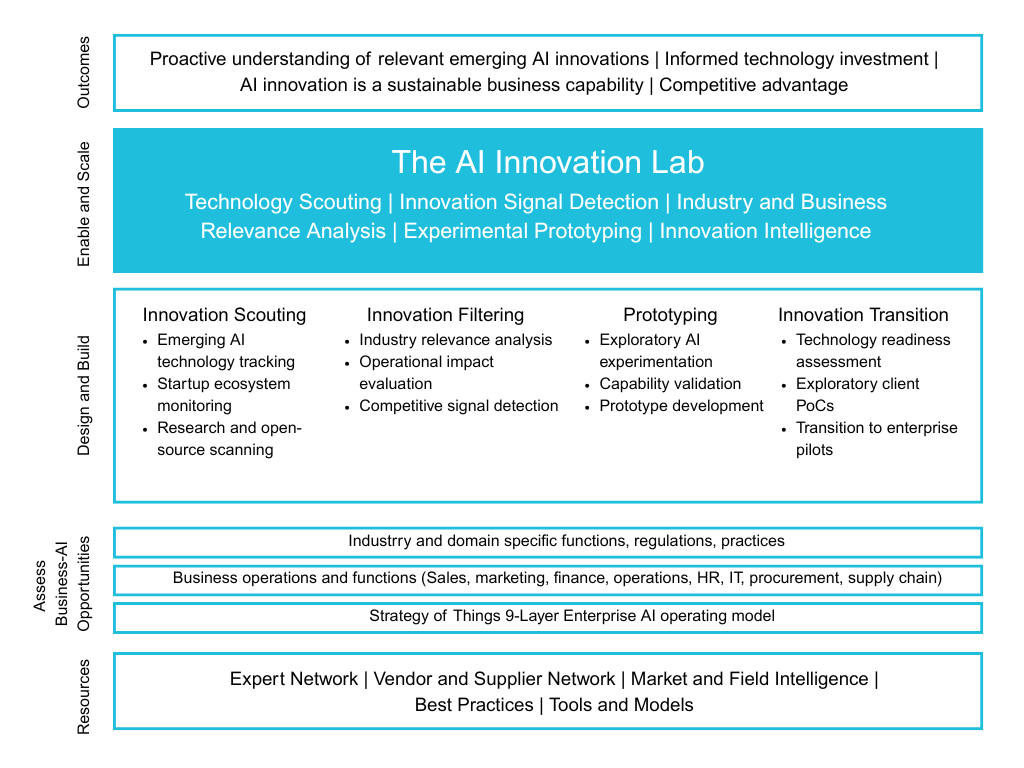
We focus on four core activities:
- Technology Scouting: Tracking emerging AI innovations across the ecosystem.
- Business Relevance Filtering: Identifying which innovations may eventually matter to a client’s industry and operations.
- Early Experimentation: Testing promising technologies to understand what they can realistically do.
- Operational Transition: Transition promising technologies to enterprise consideration, planning and investment.
This approach allows leadership teams to focus their attention on the innovations that may eventually matter to their organization — without attempting to monitor the entire AI ecosystem.
Foundations That Enable the Innovation Lab
 Building an AI innovation radar requires more than identifying technologies and trends. It requires expertise, tools, and a clear understanding of how AI interacts with the broader enterprise.
Our work is grounded in the Strategy of Things 9-Layer Enterprise AI Reference Model, which maps the full organizational surface area AI touches, from infrastructure and data architecture to governance, risk, adoption, and executive decision-making. We use this foundation to identify and discover emerging innovations and technologies.
This framework ensures that when leadership makes AI investment decisions, those decisions are supported across the technical, operational, financial, and organizational layers required for measurable impact.
We also bring the resources needed to support this structure, including:
- Our expert network
- Vendor and supplier ecosystem
- Continuously updated market and field intelligence
- Best practices gathered through research and industry engagement
- Proprietary tools and models used to evaluate, prioritize, and govern AI initiatives
Contextualized for Your Business
AI does not operate in isolation. It must align with how your organization actually runs. That means understanding how AI interacts with core business functions such as sales, marketing, finance, operations, HR, IT, procurement, and supply chain as well as the regulatory and operational realities of your industry.
Not all emerging AI innovations are relevant to your business and operations. We use this understanding of your business to identify, track and monitor the ones that matter to your organization. In this way, the AI innovation lab becomes a capability tailored to your organization.
Track and Monitor Relevant Emerging Innovations Relevant to You

We track emerging AI developments and identify which innovations may eventually become relevant to your industry, operations, and strategic priorities.
This includes:
- AI technology scouting and monitoring
- Client-specific horizon tracking
- Industry and operational relevance filtering
- Executive briefings and insight reports
- Alerts when innovations begin to mature
This allows you to stay informed about the AI developments that actually matter to your business.
Experimental AI Prototyping in a Lab Environment

We conduct exploratory prototypes and experimentation with emerging AI tools and frameworks that are not yet ready for a client environment.
This allows us to:
- Evaluate emerging technologies early
- Understand their capabilities and limitations
- Identify potential business applications
- Generate practical and usable insights
This allows you to develop an early and deep understanding of these emerging technologies and innovations without introducing risk into your operational environment.
How we work with you
Each organization operates in a different competitive environment and faces different strategic pressures. The AI innovations that matter to a retail company will not be the same as those that matter to a healthcare provider, a financial services firm, or an industrial company.
For that reason, the SoT AI Innovation Lab does not track technologies generically. We track them in the context of your business.