The AI Operating Function
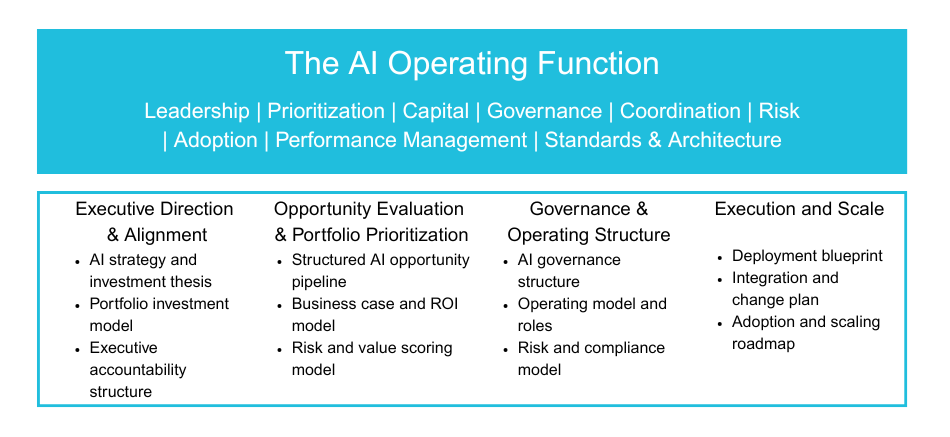
The AI Operating Function defines how artificial intelligence is managed as a business capability inside your organization.
How we build you AI operating function
 The AI Operating Function is established through four coordinated leadership areas that together govern how AI is directed, evaluated, governed, and scaled across the enterprise.
The four operating pillars
Executive Direction & Alignment
AI must begin with clear executive direction. We work with leadership to define the organization’s AI ambition, align AI investments with business priorities, and establish the executive accountability structures that guide how AI decisions are made across the enterprise.
Deliverables typically include:
• AI strategy and investment thesis
• Portfolio investment framework
• Executive accountability structure
This ensures AI becomes a coordinated investment portfolio aligned with business strategy, not a collection of isolated initiatives.
Opportunity Evaluation & Portfolio Prioritization
Most organizations generate more AI ideas than they can responsibly pursue. We introduce structured evaluation and prioritization so leadership focuses resources on the initiatives with the greatest potential impact. This includes:
- Building an AI opportunity pipeline
- Developing business cases and ROI models
- Evaluating risk and readiness
- Sequencing initiatives into a disciplined enterprise portfolio
This ensures AI investments are disciplined, defensible, and aligned with measurable outcomes.
Governance & Operating Structure
AI initiatives span multiple parts of the organization - data, infrastructure, operations, risk, and workforce adoption. We design the governance framework and operating structure that coordinates these moving parts. This includes:
- Defining decision rights
- Establishing risk oversight and compliance structures
- Coordinating cross-functional ownership
- Creating reporting and performance management mechanisms
This is where AI transitions from experimentation to a governed enterprise capability.
Execution & Scale
AI creates value only when initiatives move beyond pilots and become part of real business operations. We guide initiatives from deployment to enterprise impact by ensuring they:
- They integrate with operational workflows
- Align with enterprise architecture
- Support workforce adoption
- Scale responsibly across the organization
This ensures AI initiatives deliver sustained business outcomes rather than isolated proofs of concept.
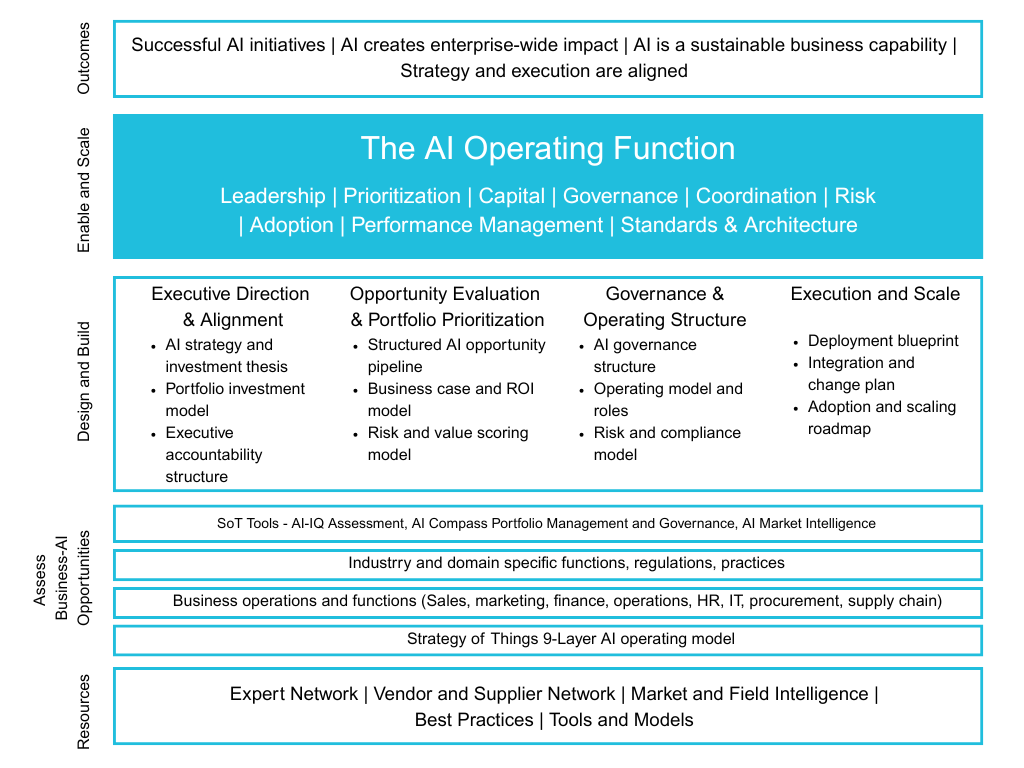
 Foundations That Enable the Operating Function
Building an AI operating function requires more than leadership coordination. It requires expertise, tools, and a clear understanding of how AI interacts with the broader enterprise.
Our work is grounded in the Strategy of Things 9-Layer Enterprise AI Reference Model, which maps the full organizational surface area AI touches, from infrastructure and data architecture to governance, risk, adoption, and executive decision-making.
This framework ensures that when leadership makes AI investment decisions, those decisions are supported across the technical, operational, financial, and organizational layers required for measurable impact.
We also bring the resources needed to support this structure, including:
- Our expert network
- Vendor and supplier ecosystem
- Continuously updated market and field intelligence
- Best practices gathered through research and industry engagement
- Proprietary tools and models used to evaluate, prioritize, and govern AI initiatives
Contextualized for Your Business
AI does not operate in isolation. Every initiative must align with how your organization actually runs.
That means understanding how AI interacts with core business functions such as sales, marketing, finance, operations, HR, IT, procurement, and supply chain as well as the regulatory and operational realities of your industry.
By combining enterprise frameworks, cross-functional knowledge, and industry context, the AI operating function becomes a capability tailored to your organization, not a generic AI program.
How we work with you
We take a hands-on collaborative approach to establish the AI operating function. If your organization already has a Chief AI Officer, we work alongside them to design and strengthen the operating function. If your organization does not yet have AI leadership at the executive level, we act as your fractional Chief AI Officer, helping design, establish, and operate the AI operating function as the capability matures.
The AI operating function is not a one-size-fits-all model. Every organization approaches AI from a different starting point. Some are exploring their first initiatives. Others already have multiple pilots underway. The leadership structure required to manage AI should reflect where your organization is today.
An early-stage company may need a lighter structure focused on prioritization and executive alignment. A more advanced organization may require deeper governance, portfolio management, and operational integration capabilities. The AI operating model is designed to evolve with your organization.
Our role is to design an operating function that fits your organization’s current maturity, strategic priorities, industry context, and operational realities without overbuilding unnecessary complexity. We establish the AI operating function through four phases.
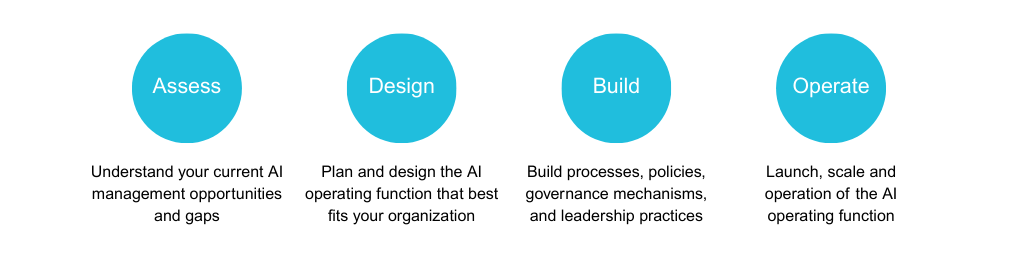
Phase 1: Assess and Understand Your Current State
We begin by developing a clear picture of how AI is currently being explored and managed inside your organization.
This includes assessing:
- Current AI initiatives and pilots
- Leadership ownership and decision structure
- Existing governance and risk oversight
- Data, infrastructure, and operational readiness
- Organizational capabilities and constraints
The goal is to understand both your opportunities and your structural gaps.
Phase 2: Design the AI Operating Function
Based on this assessment, we design the AI operating function that best fits your organization.
The design reflects:
- Your AI maturity and ambitions
- How decisions are made inside your organization
- Industry and regulatory considerations
- The level of governance and structure required today
For organizations early in their AI journey, we establish a practical structure focused on prioritization, coordination, and leadership clarity. For organizations further along, the operating function may include deeper portfolio management, governance mechanisms, and enterprise integration capabilities. In every case, the design includes a roadmap for how the operating function can evolve as AI adoption expands.
Phase 3: Build the Operating Function
Once the structure is defined, we help establish the operating function inside the organization.
This includes implementing the processes, policies, governance mechanisms, and leadership practices required to manage AI initiatives as a coordinated enterprise capability.
The goal is to ensure AI initiatives are:
- Prioritized and sequenced effectively
- Governed appropriately for risk and compliance
- Aligned with business outcomes
- Integrated with operational workflows
Phase 4: Launch and Operate the Function
After the operating function is established, we support the launch and early operation of the structure.
This includes helping leadership:
- Oversee the AI initiative portfolio
- Monitor initiative performance and impact
- Refine governance and prioritization practices
- Adjust the structure as organizational needs evolve
The operating function is designed to improve over time as AI capabilities mature.
Designed for the mid-market: fractional CAIO leadership
 Mid-market organizations rarely need, or can justify, a full time Chief AI Officer. But they do need executive AI leadership.
We embed enterprise-grade structure without permanent executive overhead. If you do not have a CAIO, we act as one. If you do, we work alongside them to strengthen and scale the operating function.
You gain:
- Strategic leadership
- Structured prioritization
- Cross-functional coordination
- Enterprise-level governance
- Capital discipline
- Execution oversight
All aligned to your scale, complexity, and budget.